
WGEA Gender Pay Gap -
Employer Statement
Overview
The Federal Government’s Workplace Gender Equality Agency (WGEA) annually publishes gender equality data for relevant reporting employers with 80 or more employees, and where applicable, their corporate group.
This Employer Statement (Statement) relates to information submitted to WGEA by the Fox HoldCo group for the 2024 -25 reporting period (2024-25), based on workforce data at 31 March 2025. For WGEA reporting purposes, the group’s entities are classified under the industry category, “Legal Services”.
Group structure
Fox HoldCo Limited (formerly QANTM Group) (Fox HoldCo) owns intellectual property (IP) businesses operating in Australia and several countries globally.
The group’s four employing entities are: Davies Collison Cave Pty Ltd (DCC), 202 employees; FPA Patent Attorneys Pty Ltd (FPA), 80 employees; Davies Collison Cave Law Pty Ltd, 29 employees; QIP Services Pty Ltd, 22 employees.
In the previous reporting period, DCC was the group’s only relevant reporting employer. In 2024–25, growth in the FPA workforce resulted in them also meeting the criteria of a relevant reporting employer, with its data therefore being published separately.
This Statement covers DCC and FPA as the group’s two relevant reporting employers with separately published data, as well as the Corporate Group, which contains aggregated results across all four employing entities.
Message from the CEO of Fox HoldCo and Directors of DCC and FPA
At the Fox HoldCo group, delivering great outcomes for clients comes down to how we work together. Our people are at the centre of our success and we want every person to feel valued for what they contribute, and respected for who they are. That’s why diversity, inclusion and belonging is part of the way we lead, collaborate and build a workplace where people can do their best work.
We view the gender pay gap as a valuable indicator as it highlights the ongoing financial impact that historical workforce patterns have on women. It also strengthens accountability and keeps focus on what matters: rewarding performance fairly and ensuring everyone has equal opportunity to grow and progress.
As a group providing intellectual property legal services, we operate in an historically male-dominated field. Reducing our gender pay gap will require sustained effort to increase women’s representation in leadership and higher-paid roles, and improving gender balance across role types.
While our gender pay gap has increased in this reporting period(1), we have strengthened our focus on thedrivers of the gap and implemented additional lead indicators designed to support sustainable change over time. We are prioritising evidence-based actions including equitable recruitment, career development, flexible work, inclusive leadership and targeted retention, particularly in historically male-dominated specialist and leadership roles.
We know this work requires sustained, long-term effort to address systemic structural and cultural drivers, and we remain committed to taking deliberate, practical steps to advance gender equality across our group.
(1) A discussion about increases in our GPG and workforce composition changes is outlined in a later section of this Statement.
What is the gender pay gap?
A common misconception is that the gender pay gap (GPG) represents men and women being paid differently for the same work (when comparing against differences such as skills, experience and responsibilities).
In comparison, the WGEA GPG reflects the difference between the collective earnings of women and men across all roles in an organisation. The GPG is the result of social and economic factors, with a significant cause being the proportion of women and men in different occupational roles and management levels.
The GPG is not only impacted by the number of women and men in higher paid roles, but also by the number of women and men in lower paid roles.
Fox HoldCo’s gender pay gaps
This section summarises Fox HoldCo’s data. Increases in our GPG and workforce composition changes are outlined in a later section of this Statement.
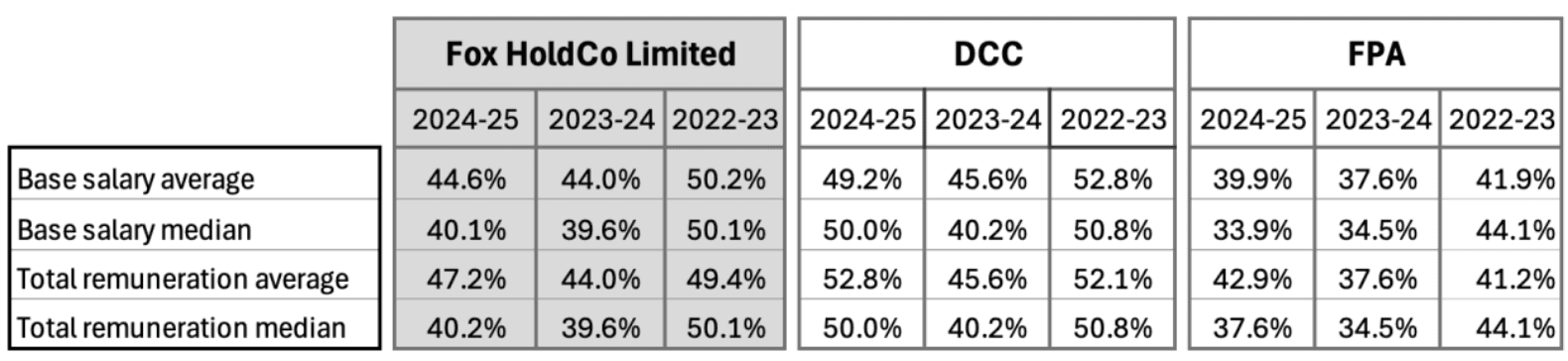
Although most GPGs for DCC, FPA and the Fox HoldCo group have decreased since the 2022-23 reporting period, they have increased between the 2023-24 reporting period (2023-24) and 2024-25. Some differences in the total remuneration GPGs between 2023–24 and 2024–25 were expected, as in 2023-24 a misunderstanding of reporting requirements resulted in base salary and total remuneration being reported as the same. This was corrected in 2024–25.
Table 1: GPGs for Fox HoldCo, DCC and FPA
What the data is telling us
Gender composition of DCC
The representation of women managers has increased from 38% in 2023-24 to 40% in 2024-25.
The representation of men as non-managers decreased from 20% in 2023-24 to 16% in 2024-25.
In 2024-25, the proportion of women in the highest-paid quartile at DCC decreased from 44% in 2023-24 to 42% in 2024-25. Conversely, women’s representation in the lowest-paid quartile increased from 79% in 2023-24 to 88% in 2024-25.
80% of all promotions from non-manager to manager roles were women.
65% of all promotions (managers and non-managers) were women.
Gender composition of FPA
The representation of women managers had no change between 2023-24 and 2024-25, at 50%.
The representation of men as non-managers decreased from 28% in 2023-24 to 22% in 2024-25.
In 2024-25, women represented 50% of the highest-paid quartile and 90% of the lowest-paid quartile.
Given FPA only became a relevant reporting employer in 2024-25, no trend quartile data is available.100% of promotions from non-manager to manager were women (x2).
64% of all promotions (managers and non-managers) were women.
Gender composition of the group
In 2024-25, the representation of women managers across the group increased to 40%, up from 38% in 2023-24. The representation of men non-managers decreased from 24% in 2023-24 to 22% in 2024-25.
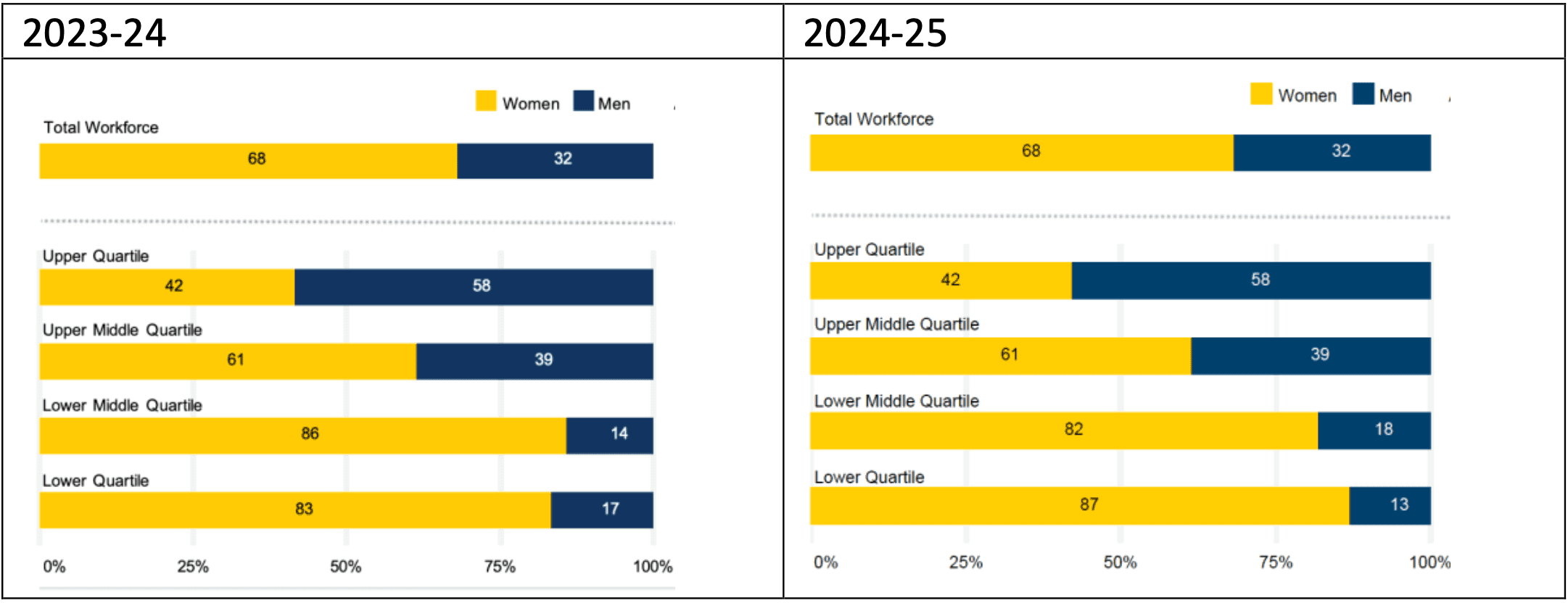
As noted above, while the proportion of women in the highest-paid quartile at DCC decreased between 2023-24 and 2024-25, there was no change across the group in the proportion of women in the two highest paid quartiles between 2023-24 and 2024-25 (42% in the upper quartile and 61% in upper middle quartile).
The proportion of women in the two lowest-paid quartiles has reversed such that the lower middle quartile decreased from 86% to 82%, but the proportion of women in the lowest quartile increased from 83% to 87%.
The representation of men in the lowest-paid quartile also decreased from 17% in 2023-24 to 13% in 2024-25.
Graph 1: Corporate group gender composition by pay quartile
Understanding Fox HoldCo’s gender pay gaps
Structure of legal and attorney firms
All companies in the Fox HoldCo group operate as corporate entities, not partnerships. Unlike partners in partnerships whose earnings are excluded from WGEA reporting, our most senior fee earners (Principals, who are equivalent to partners) are employees, so their remuneration is included in the remuneration data we report to WGEA. This results in a greater spread between our lowest and highest paid employees, which affects our GPGs. It also means our results are not directly comparable with most organisations in the Legal Services comparison group that operate as partnerships. In addition, current survey data(2) shows that in most legal partnerships, men continue to be over-represented at partnership level.
Industry context
The group’s GPGs are mainly driven by structural factors, including a higher concentration of men in senior and specialist roles as outlined below, and the sector-wide workforce patterns such as higher representation of women in administrative roles.
The highest-paid fee earners in the Fox HoldCo group are patent attorneys who need a background in science or engineering, areas that have historically been male dominated. This legacy continues to influence the pool of senior female candidates, particularly in engineering. Whilst there exists a cohort of experienced and well-paid senior women, there is a significantly larger pool of experienced and well-paid senior men with generally longer tenures in the organisation and industry which collectively contributes to the GPG.
Another industry-wide challenge(3) is that women often move into in-house roles instead of staying in private practice, influenced by factors such as billable hour expectations and caring responsibilities. In the Fox HoldCo group, while billable targets are adjusted proportionately to reduced contracted hours, we want to better understand and strengthen our employee value proposition, so these roles are attractive regardless of their gender and caring responsibilities.
(2) Australian Financial Review legal surveys.
(3) Female patent attorneys and movements around the profession: achieving non-gendered decision-making Jessica C Lai *, Ronelle Geldenhuys, Maryam Khajeh Tabari and Mark Summerfield.
Key drivers of the group’s GPGs
The group’s CEO and the subsidiaries Heads of Business are the highest paid roles in the group which are all held by men.
Principals are the highest earners, being fee-earners with their own practice. At FPA and DCC, 60% of Principals are men and 40% are women.
During the 2024-25 reporting period, one woman resigned from the DCC principalship. This contributed to the increased GPG from the previous period.
Compared to 2023-24, in 2024-25 there was a large difference in the average total remuneration for the highest paid quartile (2024-25 increased by 16%). As noted above, some of this would be due to the inclusion of superannuation, bonuses and other discretionary pay that was inadvertently omitted from total remuneration in 2023-24.
While there is gender balance in manager roles, men are more often in higher-paid fee-earning (Principal) roles and women in support roles.
Representation of men in the lowest-paid quartile decreased.
How we’re closing the GPG
During 2024-25, we undertook focused work to better understand the drivers of our GPG and to strengthen a more targeted, data-led approach to reducing it. As capability across our team has grown, our analysis has become more detailed and insight-driven, helping us identify the most effective levers for change.
We have implemented a range of evidence-based lead indicators to provide a strong foundation for progress. While operating in an historically male-dominated sector shapes workforce patterns and will take sustained effort and time to shift, we expect this work to support ongoing reductions in our GPG.
Current actions
DCC has a diversity, inclusion and belonging (DIB) strategy and action plan that is supported by two committees, one of which is the Gender Equity Committee. At both DCC and FPA, a Gender Equity Action Plan has been drafted and will be finalised in 2026. These cover areas of focus such as parental leave, pay, flexible working options, workplace behaviour, increasing representation of women, and sponsorship and advocacy.
Below are the initiatives currently in place and outcomes achieved in areas that influence our GPG:
Increasing representation of women
During 2024-25 at DCC, 63% of appointments to manager roles (including promotions) were women, which is higher than their representation in management (40%). At FPA, 80% of appointments to manager roles (including promotions) were women, which is also higher than their representation in management (50%).
We have set the following targets to increase the representation of women in key areas of the business. Our strategy and actions are designed to enable us to meet these targets by strengthening early- and mid-career development and building a sustainable pipeline into specialist and senior roles.
DCC targets: year-on-year reduction of GPG; increase the representation of women as Principals both on the Leadership Team and in the attorney workforce.
FPA targets: increase the representation of men in Business Services, increase the representation of women
At FPA, three out of the four Division Heads are women. At DCC, to strengthen accountability, succession planning and long-term capability, a new leadership structure was implemented, with five Practice Group Heads being appointed, three of whom were women (60%). These appointments support a structural step to improve gender balance in senior leadership and strengthen pathways for women into higher-paid decision-making roles.
DCC offers a bespoke patent internship program that offers science, technology, engineering and maths (STEM) university students hands-on IP experience, builds skills, and increases awareness of IP career pathways through proactive engagement and access to women role models.
To support the development of women, DCC runs a formal, research-informed sponsorship program and an in-house leadership program that equips sponsors on how to actively invest in the careers of emerging women leaders. This includes looking for opportunities to include women in networking and client development activities.To increase the representation of women in the highest paid roles, we offer trainee pathways to Principal. At DCC and FPA, Principals who are Patent Attorneys commence as Trainees (Patent Scientist or Patent Engineer) and are sponsored to complete a Masters of IP, including course fees, paid study leave and a budget fee relief while studying. After qualifying and registering as a Patent Attorney, they progress through Patent Attorney roles, ultimately to Principal. At DCC, Principals who are Trade Mark Attorneys follow a similar career trajectory as Patent Attorneys. Principals at DCC Law commence as graduates and are supported in completing their PLT.
In DCC 60% of these trainees are women (five out of eight), and in FPA 57% (four out of seven are women).External executive coaching to support transitions to Principal has been provided to women.
To reduce bias in recruitment, we use anonymous processes that remove identifying information such as names and photographs, and partner with recruitment agencies that share our commitment to diversity, equity and inclusion.
We track the number of women applying, interviewed and appointed to manager and above roles to identify potential barriers and improve our recruitment and promotion practices.
To strengthen governance, accountability and transparency, we provide mandatory DEI reporting to the Board twice each year. This includes gender representation and gender pay gaps by firm, band and team, and promotion outcomes by gender. We also monitor and report pay equity metrics, including gender pay gaps, to the Executive and Board.
We proactively engage with our industry e.g. we participate in the Australian Legal Sector Alliance, an industry association aimed at promoting best practice and inclusive workplaces.
Remuneration practices
We undertake annual gender pay equity reviews to identify and address any pay inequities.
As part of our remuneration review process, we actively deploy strategies to ensure that women’s remuneration does not, over time, inadvertently fall behind the remuneration of men in the same role.
We have embedded processes for employees on parental and extended leave, to ensure they are not disadvantaged with respect to their promotion prospects and remuneration.
Parental leave
We offer 20 weeks’ paid parental leave at full-pay regardless of gender, including superannuation on both paid and unpaid leave for the first 12 months.
In 2024–25, senior male fee earners took 20 weeks’ paid parental leave, helping to role model and support our goal of increasing men’s uptake of paid parental leave.
Fee earners on parental leave are supported to return to work through adjusted billable hours, to ease the transition and reduce the pressure that can occur in the return-to-work process.
Emergency childcare payments are made to assist during this period.
A comprehensive keep-in-touch program is in place, which has resulted in employees being promoted while on parental leave.
Family and domestic violence support covers paid leave, emergency accommodation and an emergency financial allowance.
The parental leave coaching pilot was successful, with participants providing feedback that it was very effective in supporting them through their parental leave transition and would recommend it to other colleagues.
Flexible working
In 2024-25, 37% of female managers and 21% of male managers at DCC worked part-time. At FPA, 18% of both female and male managers worked part-time. At the highest level in the business, there are men and women Principals working part-time.
We support remote working with tools and technology, with 100% of all in-person meetings supported with remote working options.
We remain committed to a hybrid model of working so have not mandated more than two ‘in-office’ days each week.
We have set targets to increase the number of men utilising flexible working arrangements, ensuring flexibility is not perceived as a “women’s issue” but instead is available to all.
Workplace Behaviour
We have a comprehensive program underpinned by our Working Together Policy, to prevent discrimination and harassment and promote psychological safety, including face-to-face training with recorded attendance, manager training on gender bias and inclusive leadership, upstander training for all staff, and regular reinforcement from senior leaders.
To identify gaps and ensure training remains effective and relevant, we consult with employees through a People at Work survey that also covers psychosocial safety, supported by focus groups and participant feedback.
Strong governance and oversight support these programs, with regular reporting to leadership and the Board. We monitor key indicators related to the prevention of, and response to, workplace sexual harassment, including monthly reporting to the Board on any bullying or sexual harassment complaints.
Future Focus
In addition to continuing with the initiatives already in place in the group, we will be undertaking the following in 2026:
Finalise Gender Equity Action Plan (2026–2029): Finalise and commence a three-year plan building on the strong foundations already in place across the group.
Deepen data analysis: Undertake deeper analysis to strengthen our understanding of the key drivers of our gender pay gap and identify additional actions to reduce it.
Strengthen succession and progression: Continue and strengthen succession planning for high- potential women, including Executive sponsorship, higher duties opportunities and access to professional development.
Implement sponsorship and leadership programs (DCC): Implement a formal, research-informed sponsorship program and a leadership program to equip sponsors to actively support the progression of emerging women leaders.
Monitor pipeline effectiveness: Monitor completion rates for career development opportunities, track leadership representation and assess the impact of initiatives on equity, progression and retention.
Build early-career pathways: Use work experience, internship and graduate programs to address under-representation, targeting at least 50% female participation across programs.
Grow STEM pipeline: Promote STEM study among girls in secondary schools to strengthen future pathways into engineering, science and other key talent pipeline areas.
Support Women in STEM: Continue to support Women in STEM initiatives and networks to build early-career capability and connection.
Expand parental leave coaching: Roll out parental leave coaching across the group.
Strengthen respectful workplace capability: Deliver a session led by a gender equity expert on the role of men in gender equity in workplaces and implement a new inclusive and respectful behaviour program (including anti-hate modules) led by the DEI Committee.
Accountability: Report an expanded range of key metrics on the use and impact of flexible working arrangements to the Executive team and Board.
Conclusion
We are committed to continuous improvement and to building a workplace culture that is safe, respectful and genuinely inclusive. During 2024-25, we have strengthened our focus on the drivers of the gap and implemented additional measures designed to support sustainable change over time.
Closing our gender pay gap remains a priority, and we will stay focused on the practical actions required to improve gender equality outcomes.
Signed:
Gerard Delaney
Chief Executive Officer
Fox HoldCo Limited
Michael Wolnizer
Director
DCC
John Dower
Director
FPA